Contrary to popular belief, in vitro fertilization (IVF) is not the most sophisticated, advanced, or cutting-edge fertility technology – but is rather the most effective fertility technology available. In order to develop a working IVF plan, new patients generally schedule an initial consult with an IVF Coordinator, coupled with an initial Patient History and IVF Education Session to begin understanding the 5 Stages of IVF. However, IVF is commonly seen as a complex series of medical procedures; a straightforward breakdown of the available options in the form of several phased approaches made it easier for patients.
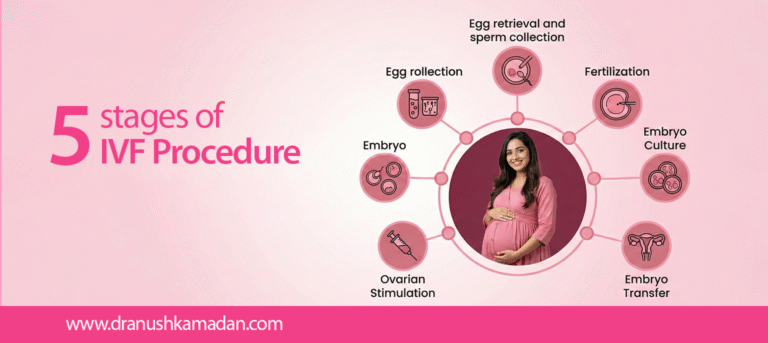
This guide explains the 5 stage of IVF in a simple, visually appealing format, helping laypersons understand each step clearly and confidently.
What are the 5 Stages of IVF?
The IVF process includes five key steps
- Ovarian Stimulation
- Egg Retrieval Procedure
- Embryo Development
- Embryo Transfer
- Pregnancy Testing and Monitoring
1: Ovarian Stimulation
Ovarian stimulation is the first of the five stages of IVF, designed to prompt the ovaries to produce multiple mature eggs in one cycle. Since the success rates of IVF are correlated with the number of eggs available for use, this stage is especially important.
What Happens During Ovarian Stimulation
- You begin taking fertility medications (injectable gonadotropins).
- Regular ultrasound monitoring evaluates follicle growth.
- Blood tests track hormone levels such as estradiol.
Why This Stage Matters
The chances your body will produce a viable embryo increase significantly if you can produce a lot of healthy eggs. Associated keywords of this step in the process include controlled ovarian hyperstimulation, ovarian response, fertility hormones, and follicle development.
2: Egg Retrieval Procedure
Egg retrieval is the second step in the 5 stages of IVF, performed when the follicles have reached optimal size. The process is minimally invasive and usually completed within 15–20 minutes.
What to Expect
- A “trigger shot” (hCG or Lupron) prompts final egg maturation.
- A fertility specialist retrieves the eggs using ultrasound-guided aspiration.
- Light sedation ensures the procedure remains comfortable.
After the Procedure
Most patients rest for a short period before going home. Eggs are immediately handed to the embryology lab for evaluation.
3: Fertilization and Early Embryo Development
Fertilization marks the midpoint of the 5 stages of IVF, where science and biology work together to create embryos. This is one of the most closely monitored phases in the IVF lab.
How Fertilization Occurs
- Eggs are combined with sperm in a controlled lab setting.
- In cases of male-factor infertility, ICSI (Intracytoplasmic Sperm Injection) is used.
- Embryologists monitor fertilization and cell division over several days.
Key Terms in This Stage
Embryo grading, blastocyst development, insemination, fertilization rate, and embryology culture systems.
4: Embryo Transfer
Embryo transfer is the fourth milestone within the 5 stages of IVF, and it marks the moment when a healthy embryo is placed into the uterus to support implantation.
How the Transfer Works
- Typically performed on Day 3 or Day 5 (blastocyst).
- A thin catheter is used to place the embryo gently into the uterus.
- The process is quick, painless, and does not require anesthesia.
Doctors often recommend transferring one high-quality embryo to reduce the risk of multiples while maintaining strong success rates.
5: Pregnancy Testing and Monitoring
The final step in the 5 stages of IVF brings the cycle full circle. About 10–14 days after the embryo transfer, you’ll undergo a blood test to measure hCG, the pregnancy hormone.
Two Parts of This Stage
- Beta hCG test – Confirms the presence of pregnancy.
- Follow-up monitoring – Ensures the embryo implants and progresses normally.
This stage often brings emotional anticipation, making support and communication with your care team essential.
How Long Do the 5 Stages of IVF Take?
On average, the complete cycle timeline for the 5 stages of IVF spans 4–6 weeks, depending on individual response and the clinic’s protocol. Some cycles may be longer if additional testing or preparation is required.
What Affects Success During the 5 Stages of IVF?
Several factors can influence outcomes:
- Age and ovarian reserve
- Embryo quality and genetics
- Sperm health
- Uterine receptivity
- Lifestyle factors (nutrition, stress, environment)
Many couples and individuals undergo multiple cycles before achieving their desired outcome. Understanding the 5 stages of IVF helps clarify expectations and empowers better decision-making.
FAQs About the 5 Stages of IVF
1. How painful are the 5 stages of IVF?
Most stages involve minimal discomfort. Egg retrieval requires sedation, while other steps typically feel similar to standard medical procedures.
2. How many eggs are needed for IVF?
Doctors prefer retrieving 8–15 eggs, but successful cycles can occur with fewer, depending on egg quality.
3. Can the 5 stages of IVF be customized?
Yes. IVF protocols are tailored to your hormones, age, fertility diagnosis, and prior treatment history.
4. What are the risks of IVF?
Common risks include ovarian hyperstimulation syndrome (OHSS), multiple pregnancies, and cycle cancellation, though these are managed with modern protocols.
5. How soon can I try again after a failed cycle?
Most clinics recommend waiting 1–2 menstrual cycles, but your doctor will advise based on your physical and emotional readiness.
Conclusion
Anyone preparing to embark on fertility treatment must first understand these 5 stages of IVF. Each of these steps, ovarian stimulation, egg retrieval, fertilization, embryo transfer, and pregnancy testing, forms a pattern for your fertility journey and helps you develop clarity and confidence.
Keeping yourself informed helps you eliminate a lot of uncertainties, and that is why having knowledge of the process is one of the best tools you can have for IVF. Each cycle that you complete, in partnership with your providers, will help you get a step closer to achieving the family of your dreams.
You are looking for an IVF Consultation. Contact Dr. Anushka Madan. Get IVF Centre Loction