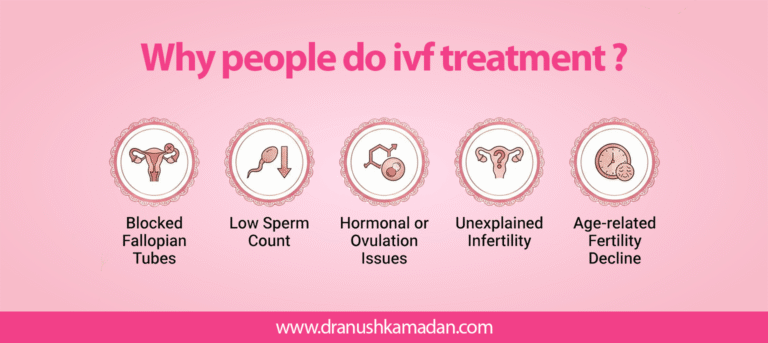
For many couples, IVF (In Vitro Fertilization) represents hope — a chance to experience parenthood when natural conception isn’t possible or has repeatedly failed. This is why people do IVF treatment: it offers a scientific and emotional pathway to overcome fertility challenges through advanced reproductive technology.
1. When Natural Conception Becomes Difficult
Usually, pregnancy occurs when a woman’s egg is fertilized by sperm inside her fallopian tube.
But if this process doesn’t happen due to medical or unexplained reasons, IVF helps by fertilizing the egg outside the body (in a lab) and then transferring the embryo back into the uterus.
2. Common Medical Reasons Why People Need IVF
Here are the most frequent conditions that lead couples to choose IVF:
a. Blocked or Damaged Fallopian Tubes
If the fallopian tubes are blocked or scarred, the egg and sperm cannot meet naturally.
IVF bypasses the tubes entirely, making conception possible.
b. Male Infertility (Low Sperm Count or Motility)
When sperm count, movement, or shape is poor, natural fertilization becomes difficult.
In IVF, a specialized technique called ICSI (Intracytoplasmic Sperm Injection) can inject a single healthy sperm directly into the egg.
c. Age-Related Infertility
A woman’s fertility declines after age 35 due to lower egg quality and quantity.
IVF helps by stimulating the ovaries to produce multiple eggs and selecting the healthiest embryos for transfer.
d. Endometriosis
Endometriosis can affect the ovaries, tubes, and uterine lining, making it difficult for embryos to implant naturally.
IVF improves the chances by placing embryos directly into the uterus under controlled conditions.
e. Polycystic Ovary Syndrome (PCOS)
Women with PCOS often have irregular ovulation or poor egg quality.
IVF allows doctors to control ovulation, retrieve healthy eggs, and maximize success rates.
f. Unexplained Infertility
Sometimes, all tests are normal — yet pregnancy doesn’t occur.
In such cases, IVF provides a controlled and precise environment for fertilization that natural conception can’t guarantee.
g. Uterine or Cervical Issues
Thick cervical mucus or uterine abnormalities can prevent sperm from reaching the egg.
IVF eliminates these barriers by fertilizing the egg outside the body.
h. Genetic or Hereditary Conditions
If one partner carries a genetic disorder, Preimplantation Genetic Testing (PGT) can be done during IVF to ensure only healthy embryos are transferred, reducing the risk of passing on inherited diseases.
I. Single Parents & Same-Sex Couples
IVF with donor eggs, sperm, or gestational surrogacy enables same-sex couples and single individuals to become parents — a wonderful example of how science supports modern families.
3. When IVF Is Recommended After Failed Treatments
Before IVF, doctors may try other fertility treatments like:
- Ovulation induction (fertility tablets)
- IUI (Intrauterine Insemination)
If these fail after several cycles, IVF becomes the next logical step for achieving pregnancy — especially for women above 35 or with severe fertility issues.
4. IVF Offers Hope After Miscarriages
For couples with recurrent pregnancy loss, IVF can help identify and select chromosomally normal embryos, increasing the chance of a successful, healthy pregnancy.
5. IVF Gives Emotional Closure and Control
Beyond medical reasons, IVF provides emotional peace to many couples who have tried for years without success.
It allows them to take an active, hopeful step toward parenthood under expert medical supervision.
Dr. Anushka Madan’s Expert View
“IVF isn’t the first step in fertility care, but it’s often the most effective one for couples who’ve tried everything else. With modern technology, success rates are improving every year, helping more families experience the joy of parenthood.”
— Dr. Anushka Madan, Fertility & IVF Specialist
FAQs About IVF Treatment
1. Who is a good candidate for IVF?
Couples who’ve tried for over a year without conception, or those with blocked tubes, PCOS, or low sperm count, are ideal candidates.
2. How successful is IVF?
Success depends on age and medical factors — typically 50–60% success rate per cycle for women under 35 with good embryo quality.
3. Is IVF painful?
Most procedures are done under mild sedation. Some mild bloating or cramping can occur but is temporary.
4. Can IVF guarantee a baby?
No treatment can guarantee pregnancy, but IVF offers the highest success rate among all fertility treatments.
5. Can IVF help after miscarriage?
Yes. IVF with genetic testing can identify healthy embryos, reducing miscarriage risk.
Conclusion
People choose IVF not just because they can’t conceive, but because they want a chance to try everything possible to become parents. Thanks to medical advancements and compassionate care from specialists like Dr. Anushka Madan, IVF brings new hope to countless families worldwide. Every IVF story is one of strength, resilience, and love — proof that miracles can be created through science and patience.
If you’re beginning your parenthood journey and looking for the best infertility centre near you, Dr. Anushka Madan at Vrinda Fertility is one of the most trusted IVF specialists to guide you. Get Direction