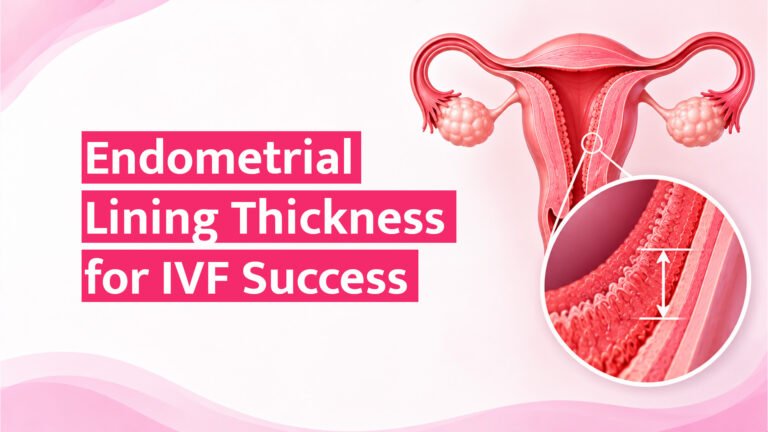
What Is Endometrial Lining Thickness
Endometrial lining thickness refers to the measurement of the inner lining of the uterus, also known as the endometrium. During an IVF cycle, fertility specialists monitor this lining because it provides the environment where an embryo may implant and continue developing.
In general, an endometrial thickness of around 7–10 mm is commonly considered favorable around the time of embryo transfer. Several studies have found that very thin endometrium, particularly below approximately 6–7 mm, is associated with lower average implantation and live-birth rates.
However, there is no single thickness that guarantees IVF success.
Embryo quality, maternal age, uterine health, hormonal preparation, progesterone exposure, and embryo-transfer timing can all influence the outcome.
Quick Answer
What endometrial thickness is best for IVF?
An endometrial lining of approximately 7–10 mm is generally considered favorable for embryo transfer. Around 8–10 mm is often reassuring, while a lining below 6–7 mm may be associated with lower IVF success rates.
That said, pregnancy can occur with a thinner lining, and having a thicker lining does not guarantee pregnancy.
What Is the Endometrium?
The endometrium is the innermost layer of the uterus. It changes throughout the menstrual cycle under the influence of reproductive hormones, particularly estrogen and progesterone.
During the first part of the cycle, estrogen stimulates the endometrium to grow. After ovulation, progesterone changes the lining and prepares it for possible embryo implantation.
The endometrium generally goes through these stages:
Menstrual Phase
During menstruation, the previous uterine lining is shed, resulting in a relatively thin endometrium.
Proliferative Phase
Estrogen stimulates the lining to grow and become thicker.
Around Ovulation
The endometrium continues developing and may show a characteristic trilaminar or triple-line appearance on ultrasound.
Secretory Phase
After ovulation, progesterone causes further changes that make the endometrium more suitable for potential implantation.
This is why an endometrial measurement should always be interpreted according to the cycle day and IVF treatment stage.
What Is the Ideal Endometrial Thickness for IVF?
There is no universally accepted “perfect” endometrial thickness for IVF.
Nevertheless, 7–10 mm is frequently regarded as a favorable range in clinical practice and research.
A large study involving more than 96,000 autologous embryo-transfer cycles found that live-birth rates increased with increasing endometrial thickness in fresh embryo-transfer cycles up to approximately 10–12 mm. In frozen embryo-transfer cycles, outcomes generally plateaued around 7–10 mm. Endometrial thickness below 6 mm was associated with a substantial reduction in live-birth rates.
Another large study involving more than 44,000 fresh and frozen embryo-transfer cycles found that pregnancy and live-birth outcomes were less favorable below approximately 8 mm in fresh cycles and below approximately 7 mm in frozen-thaw cycles.
These findings suggest that very thin endometrium may be an important consideration, but they do not establish one universal cutoff for every IVF patient.
Endometrial Thickness Chart for IVF
The following chart provides a general way to understand endometrial measurements reported during fertility treatment:
| Endometrial Thickness | General IVF Interpretation |
|---|---|
| Below 6 mm | Very thin; associated with lower average success rates |
| 6–6.9 mm | Relatively thin |
| 7–7.9 mm | Often considered acceptable/favorable |
| 8–9.9 mm | Generally favorable |
| 10–12 mm | Favorable in many fresh-transfer studies |
| Above 12–14 mm | Should be interpreted with other ultrasound findings |
These ranges are not strict medical cutoffs. Your fertility specialist may recommend proceeding with or delaying embryo transfer based on your individual circumstances.
Is 6 mm Endometrial Thickness Too Thin for IVF?
An endometrial thickness of 6 mm or less is generally considered thin.
Research has associated very thin endometrium with lower implantation, clinical pregnancy, and live-birth rates in IVF populations.
A large analysis found particularly reduced live-birth rates when endometrial thickness was below 6 mm.
However, this does not mean pregnancy is impossible with a 6 mm lining.
Your fertility specialist may consider:
- Whether the lining has consistently remained thin
- Estrogen response
- Uterine anatomy
- Previous uterine procedures
- Possible intrauterine adhesions
- Embryo quality
- IVF protocol
- Whether additional preparation time is appropriate
Therefore, a 6 mm measurement should be interpreted in context rather than treated as an automatic IVF failure.
Is 7 mm Endometrial Thickness Good for IVF?
Yes. A 7 mm endometrial lining can be suitable for embryo transfer and successful pregnancy.
A 7 mm measurement has historically been used as an important reference point in IVF research.
A systematic review and meta-analysis found that an endometrial thickness of 7 mm or less was associated with lower clinical pregnancy rates compared with greater thickness, but also concluded that endometrial thickness has limited ability to predict an individual’s outcome. The authors did not support using 7 mm as an automatic reason to cancel treatment.
Therefore:
7 mm does not mean IVF will fail.
It simply falls toward the thinner end of the range that is commonly considered favorable.
Is 8 mm Endometrial Thickness Good for IVF Success?
Yes. An 8 mm lining is generally considered favorable for IVF and embryo transfer.
If the endometrium measures approximately 8 mm and has an appropriate ultrasound appearance, this can be a reassuring finding.
However, the difference between 8 mm, 9 mm, and 10 mm should not be overinterpreted.
One large study of more than 7,000 blastocyst-transfer cycles compared endometrial thicknesses of 7.0–7.9 mm, 8.0–8.9 mm, and 9.0–9.9 mm. Although unadjusted outcomes varied, after adjusting for relevant factors, the differences in live-birth rates were no longer statistically significant.
This highlights an important point:
Once the lining reaches a favorable range, thicker does not necessarily mean better.
Is 9 mm Endometrial Thickness Ideal for IVF?
A 9 mm endometrial lining is generally within the favorable range used in IVF treatment.
A lining of this thickness may indicate a good response to estrogen preparation, especially when the ultrasound appearance is also appropriate.
However, 9 mm should not be considered a mandatory target.
IVF success depends on multiple factors, and a difference of 1–2 mm does not necessarily translate into a meaningful difference in pregnancy outcomes for an individual patient.
Is 10 mm Endometrial Thickness Best for IVF?
A 10 mm endometrial lining is commonly considered favorable and has been associated with good outcomes in several IVF studies.
One large study involving more than 25,000 fresh embryo-transfer cycles found that live-birth rates increased as endometrial thickness increased, with approximately 10 mm associated with favorable outcomes.
However, this does not mean that every IVF patient needs a 10 mm lining before embryo transfer.
Other large studies have found that outcomes in frozen embryo-transfer cycles tend to plateau around 7–10 mm.
Therefore, 10 mm can be an excellent measurement, but it is not a required number for IVF success.
Does a Thicker Endometrium Always Mean Higher IVF Success?
No.
The relationship between endometrial thickness and IVF success is more complicated than simply saying “thicker is better.”
Very thin endometrium is consistently more concerning in IVF research. However, once the lining reaches a favorable range, increasing it further may not provide a significant additional benefit.
A meta-analysis found poorer IVF outcomes when endometrial thickness was below 7 mm, while thickness above 14 mm was not clearly associated with worse pregnancy outcomes compared with intermediate measurements.
Therefore, doctors evaluate thickness alongside:
- Endometrial pattern
- Hormonal levels
- Uterine anatomy
- Embryo quality
- Progesterone timing
- Overall IVF protocol
What Is a Thin Endometrium?
A thin endometrium generally refers to a uterine lining that is thinner than expected at the time of ovulation or embryo transfer.
There is no universally accepted definition, but research commonly uses less than 7 mm as a reference for thin endometrium. Measurements below 6 mm are particularly associated with less favorable IVF outcomes.
Possible causes include:
- Previous uterine procedures
- Intrauterine adhesions
- Previous uterine inflammation or infection
- Hormonal factors
- Inadequate estrogen response
- Certain fertility-treatment protocols
- Uterine abnormalities
- Sometimes, no identifiable cause
A thin lining does not mean that pregnancy is impossible. It may simply indicate a lower average probability of success in some IVF populations.
What Is a Trilaminar Endometrium?
Endometrial thickness is not the only ultrasound feature fertility specialists may assess.
Around ovulation, the endometrium can develop a characteristic trilaminar or triple-line pattern. This appearance consists of distinct layers that can be seen on ultrasound.
A trilaminar pattern is often considered a favorable sign during fertility treatment.
However, endometrial appearance alone cannot predict IVF success. It must be considered together with thickness, hormonal preparation, embryo quality, and other clinical factors.
Can Endometrial Thickness Be Improved Before IVF?
If the endometrium repeatedly remains thin, the first step is generally to identify the possible underlying cause.
Depending on the individual situation, a fertility specialist may evaluate:
- Estrogen response
- Uterine cavity
- Intrauterine adhesions
- Polyps
- Fibroids
- Previous uterine surgery
- Hormonal preparation
- Ovulation timing
- Progesterone exposure
- IVF or FET protocol
Some patients may require changes to their hormonal preparation or treatment protocol.
However, not every treatment promoted online for “improving uterine lining” has strong scientific evidence.
For example, evidence regarding treatments such as granulocyte colony-stimulating factor (G-CSF) remains heterogeneous, and further research is needed.
Patients should therefore avoid starting medications, supplements, aspirin, hormones, or procedures without discussing them with their fertility specialist.
Fresh IVF vs. Frozen Embryo Transfer
The relationship between endometrial thickness and IVF outcomes may differ between fresh embryo transfer and frozen embryo transfer (FET).
Large studies have found that in fresh cycles, live-birth rates may continue increasing at greater thicknesses up to around 10–12 mm, whereas in frozen cycles outcomes may plateau around 7–10 mm.
Therefore, there is no need to apply exactly the same thickness target to every IVF cycle.
Your fertility clinic may consider:
- Type of embryo transfer
- Embryo stage
- Hormonal preparation
- Endometrial pattern
- Previous IVF history
- Uterine health
When Is Endometrial Thickness Measured During IVF?
The timing depends on the type of IVF treatment.
During a Fresh IVF Cycle
Ultrasound may be used during ovarian stimulation to monitor the development of the endometrium along with follicular growth.
During a Frozen Embryo Transfer
In a medicated FET cycle, the endometrium is typically monitored during estrogen preparation before progesterone and embryo transfer are scheduled according to the clinic’s protocol.
During a Natural FET Cycle
Endometrial development may be assessed around the time of ovulation.
Because the lining naturally changes throughout the menstrual cycle, a measurement such as “8 mm” has to be interpreted alongside the cycle day and treatment stage.
What Else Affects IVF Success Besides Endometrial Thickness?
Endometrial thickness is only one piece of the IVF success puzzle.
1. Embryo Quality
The developmental and genetic potential of the embryo is a major factor influencing implantation and pregnancy.
2. Maternal Age
Age can affect egg quality and embryo chromosomal health, which can substantially influence IVF outcomes.
3. Uterine Health
Polyps, cavity-distorting fibroids, adhesions, and other uterine abnormalities may affect implantation.
4. Hormonal Synchronization
For frozen embryo transfer, the timing of progesterone exposure relative to embryo development is particularly important.
5. Embryo Transfer Timing and Technique
The timing and technical aspects of embryo transfer also contribute to overall treatment outcomes.
For this reason, endometrial thickness should never be used as the only predictor of IVF success.
Conclusion
Endometrial lining thickness is an important consideration in IVF, but it is not the only factor that determines success.
A lining of approximately 7–10 mm is commonly considered favorable for embryo transfer. Measurements around 8–10 mm are often reassuring, while very thin endometrium, particularly below 6–7 mm, has been associated with lower average implantation and live-birth rates in IVF research.
However, 7 mm does not mean IVF will fail, and 10 mm does not guarantee pregnancy.
The most meaningful assessment considers endometrial thickness together with embryo quality, maternal age, uterine health, endometrial pattern, hormonal preparation, progesterone timing, and embryo-transfer timing.
If your endometrial lining measures 6 mm, 7 mm, 8 mm, 9 mm, or 10 mm, discuss the result with your fertility specialist in the context of your complete IVF treatment plan rather than relying on the thickness measurement alone.
Medical Disclaimer: This article is for educational purposes only and should not replace individualized medical advice, diagnosis, or treatment from a qualified gynecologist or reproductive-medicine specialist.
Visit Vrinda Fertility
Take the next step toward your parenthood journey with expert fertility care, advanced treatments, and personalized treatment plans.
Visit Vrinda Fertility today and consult experienced fertility specialists to understand your fertility needs and explore the right treatment options for you.
Book Your Consultation → Delhi / Noida / Dehradun .