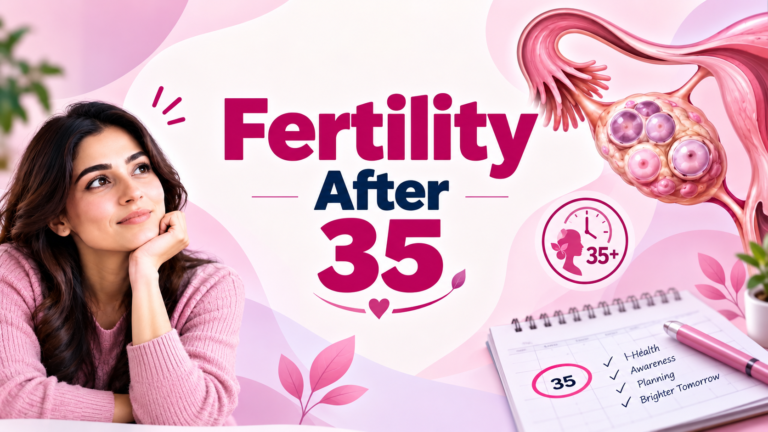
Trying to conceive after 35 is increasingly common. Many women have healthy pregnancies in their late 30s and beyond. However, fertility does change with age, and understanding these changes can help women make informed decisions about pregnancy planning and fertility care.
The most significant age-related changes involve egg quantity and egg quality. As women get older, the number of available eggs gradually decreases, while the likelihood of chromosomal abnormalities in eggs increases. This can make conception more difficult and can also increase the risk of miscarriage.
That does not mean pregnancy after 35 is impossible. It simply means that age becomes a more important factor when planning a family.
What Happens to Female Fertility After 35?
Women are born with a finite number of eggs. Over time, the ovarian reserve naturally declines.
By the mid-30s, this decline becomes more noticeable, and the rate of decline generally accelerates as women approach their 40s.
Age can affect fertility in several ways:
- Fewer eggs remain in the ovaries.
- Egg quality gradually declines.
- Ovulation may become less predictable in some women.
- The chance of chromosomal abnormalities increases.
- It may take longer to conceive.
- The risk of miscarriage increases with age.
However, fertility varies considerably from woman to woman. Age is an important factor, but it is not the only factor that determines the likelihood of pregnancy.
Why Does Egg Quality Decline With Age?
Egg quality is one of the most important factors affecting fertility after 35.
As eggs age, they become more likely to develop problems with chromosome separation during cell division. This can result in embryos with abnormal chromosome numbers.
Some chromosomal abnormalities may prevent an embryo from implanting or developing normally, while others can increase the risk of miscarriage or certain genetic conditions.
This is one of the major reasons why reproductive outcomes change with increasing maternal age.
Importantly, there is no single routine test that can completely measure egg quality.
What Is Ovarian Reserve?
Ovarian reserve refers to the approximate number of eggs remaining in the ovaries.
Doctors may use several tests to assess ovarian reserve, including:
AMH Test
Anti-Müllerian hormone (AMH) testing can provide an estimate of ovarian reserve.
Antral Follicle Count
An ultrasound can be used to count small follicles within the ovaries.
FSH Testing
Follicle-stimulating hormone (FSH) may be measured in certain situations as part of a fertility evaluation.
These tests can provide useful information, but they should not be interpreted in isolation.
For example, AMH can help estimate egg quantity but does not independently predict whether a woman will naturally become pregnant.
Does Fertility Suddenly Drop at 35?
No.
There is no biological switch that suddenly turns off fertility on a woman’s 35th birthday.
Fertility declines gradually with age, although the decline becomes more clinically significant during the mid-to-late 30s.
Some women may conceive quickly at 36 or 37, while others may experience difficulty conceiving at a younger age.
Therefore, 35 should be viewed as an important fertility milestone rather than a strict cutoff for pregnancy.
Can Women Get Pregnant Naturally After 35?
Yes.
Many women conceive naturally after 35 and have healthy pregnancies and babies.
However, the probability of conception during each menstrual cycle generally decreases with age.
Several factors influence an individual’s chances, including:
- Age
- Egg quality
- Ovarian reserve
- Ovulation
- Fallopian tube health
- Uterine health
- Endometriosis or other reproductive conditions
- Sperm quality
- Frequency and timing of intercourse
- Overall health
This is why a fertility assessment should consider both partners when pregnancy does not occur as expected.
What Are the Risks of Pregnancy After 35?
Pregnancy after 35 can be healthy, but some pregnancy-related risks become more common with increasing maternal age.
These may include:
- Miscarriage
- Chromosomal abnormalities
- Gestational diabetes
- High blood pressure during pregnancy
- Preeclampsia
- Certain pregnancy complications
The actual risk varies significantly depending on age and individual health.
Being over 35 does not automatically mean that a pregnancy will be high-risk or complicated.
Regular prenatal care helps doctors identify and manage potential problems early.
When Should You See a Fertility Specialist After 35?
Timing matters when trying to conceive.
For women 35 or older, fertility evaluation is generally recommended after 6 months of regular unprotected intercourse without pregnancy.
You may want to seek medical advice sooner if you have:
- Irregular or absent periods
- Suspected ovulation problems
- Endometriosis
- Previous pelvic surgery
- A history of pelvic infections
- Known fallopian tube problems
- Previous chemotherapy or radiation
- Recurrent miscarriage
- A known or suspected male fertility problem
For women over 40, doctors may recommend an earlier evaluation rather than waiting six months.
Fertility Tests After 35
A fertility specialist may recommend several tests depending on your medical history.
1. AMH Testing
AMH can help assess ovarian reserve and may help doctors plan fertility treatment.
2. Antral Follicle Count
This ultrasound assessment estimates the number of developing follicles in the ovaries.
3. Ovulation Assessment
If menstrual cycles are irregular, your doctor may evaluate whether ovulation is occurring regularly.
4. Pelvic Ultrasound
Ultrasound can evaluate the uterus and ovaries and identify certain structural problems.
5. Fallopian Tube Testing
Tests such as hysterosalpingography (HSG) may be recommended to determine whether the fallopian tubes are open.
6. Semen Analysis
Male fertility factors contribute to a significant proportion of infertility cases. A semen analysis may therefore be an important part of a couple’s fertility evaluation.
How to Improve Fertility After 35
Age cannot be reversed, but maintaining good overall health can support reproductive health and prepare the body for pregnancy.
Maintain a Healthy Weight
Being significantly underweight or overweight can affect ovulation and pregnancy health.
Eat a Balanced Diet
Focus on a varied diet containing vegetables, fruits, whole grains, protein sources, and essential nutrients.
Exercise Regularly
Moderate physical activity can support overall health and help maintain a healthy weight.
Avoid Smoking
Smoking can negatively affect fertility and is associated with several pregnancy complications.
Limit or Avoid Alcohol
If you are trying to conceive or could become pregnant, avoiding alcohol is the safest approach.
Take Folic Acid
Women planning pregnancy are generally advised to take folic acid before conception. The appropriate dose should be discussed with a healthcare professional.
Review Medications
Some prescription and over-the-counter medications may not be appropriate during pregnancy. Discuss regular medications and supplements with your doctor before trying to conceive.
Does IVF Work After 35?
IVF can be an option for women who have difficulty conceiving naturally or who have specific fertility problems.
During IVF, medications are used to stimulate the ovaries, eggs are retrieved, and fertilization takes place in a laboratory. A resulting embryo may then be transferred to the uterus.
However, IVF does not completely overcome age-related changes in egg quality.
Because egg quality generally declines with age, the woman’s age at the time of egg retrieval is an important factor in IVF outcomes.
Depending on individual circumstances, a fertility specialist may discuss:
- IVF
- Embryo freezing
- Egg freezing
- Genetic testing of embryos when appropriate
- Donor eggs
- Other assisted reproductive options
The most appropriate treatment depends on the individual’s fertility assessment and reproductive goals.
Egg Freezing After 35
Egg freezing, also known as oocyte cryopreservation, allows eggs to be retrieved and frozen for potential future use.
The potential advantage is that the eggs are preserved at the age when they were collected.
However, egg freezing is not a guarantee of future pregnancy.
The number of eggs retrieved, the woman’s age when eggs are frozen, egg quality, and future embryo development all influence the likelihood of a successful pregnancy.
Women considering egg freezing should discuss realistic expectations and individual circumstances with a fertility specialist.
Pregnancy Planning After 35
If you are planning a pregnancy after 35, consider scheduling a preconception consultation.
Your healthcare provider may review:
- Medical history
- Previous pregnancies
- Menstrual cycles
- Current medications
- Vaccination status
- Existing health conditions
- Lifestyle factors
- Family history
- Fertility concerns
This can help identify issues that may need attention before pregnancy.
Fertility After 40: What Changes?
The decline in fertility generally becomes more pronounced during the 40s.
Compared with the late 30s, women in their 40s are more likely to experience:
- Lower ovarian reserve
- Reduced egg quality
- Lower chances of natural conception
- Higher miscarriage risk
- Higher likelihood of chromosomal abnormalities
For this reason, women over 40 who want to become pregnant may benefit from speaking with a fertility specialist early in the process.
Does a High AMH Mean You Can Easily Get Pregnant?
Not necessarily.
AMH is primarily an indicator of ovarian reserve. A higher AMH level can indicate a larger remaining pool of eggs, but it does not directly measure egg quality.
Pregnancy depends on multiple factors, including:
- Egg quality
- Ovulation
- Sperm quality
- Fallopian tube function
- Uterine health
- Embryo development
- Age
Therefore, AMH should be interpreted as one part of a broader fertility assessment.
Key Takeaways
- Female fertility gradually declines with age.
- The decline becomes more noticeable during the mid-to-late 30s.
- Egg quality and egg quantity are both affected by aging.
- The risk of miscarriage and chromosomal abnormalities increases with maternal age.
- Many women can still conceive naturally after 35.
- Women aged 35 or older generally should consider fertility evaluation after six months of trying without success.
- Women over 40 may benefit from seeking evaluation sooner.
- AMH and ultrasound can help assess ovarian reserve but cannot predict fertility on their own.
- IVF and other fertility treatments may provide options when conception is difficult.
- Healthy lifestyle choices and preconception care can support pregnancy planning.
Conclusion
Fertility after 35 is different from fertility in the 20s and early 30s, but turning 35 does not mean that pregnancy is no longer possible. The most important age-related changes involve declining egg quantity and quality, which can make conception more difficult and increase certain pregnancy risks.
If you are planning a family in your mid-30s or later, understanding your reproductive health and seeking medical advice at the appropriate time can help you make informed decisions. If pregnancy does not occur after six months of trying, or if you already have a known fertility concern, consider speaking with a fertility specialist.
With appropriate evaluation, personalized care, and realistic expectations, there are several paths available to women who want to build their families after 35.
Medical disclaimer: This article is for educational purposes only and should not replace individualized medical advice from a qualified healthcare professional.
Visit Vrinda Fertility
Take the next step toward your parenthood journey with expert fertility care, advanced treatments, and personalized treatment plans.
Visit Vrinda Fertility today and consult experienced fertility specialists to understand your fertility needs and explore the right treatment options for you.