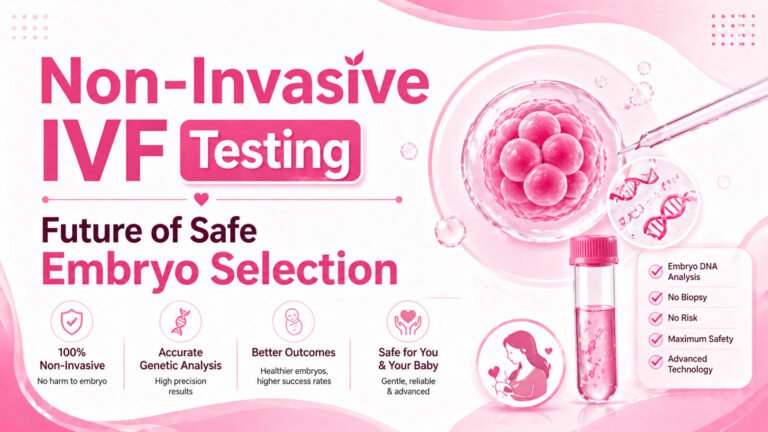
Non-invasive IVF testing is huge in improving the safety, effectiveness, and precision of assisted reproductive technology. This testing provides more reliable options in the embryo selection processes for intended parents, and more clinics are adopting this testing.
Artificial reproductive technology (ART) procedures are constantly evolving due to innovations in reproductive medicine, one of which is **non-invasive IVF testing**. Biopsy procedures are typically used for embryo health testing. These biopsy procedures can mildly affect embryo viability. However, with non-invasive IVF testing, health can be assessed with no direct testing/interference.
What Is Non-Invasive IVF Testing?
Non-invasive IVF testing is one of the latest techniques of in vitro fertilization (IVF) and involves the genetic analysis of a culture media released from an embryo. Unlike the techniques of pre-implantation genetic testing (PGT), this technique removes the physical cell extraction used during in vivo (live) testing.
Key Features:
- No embryo biopsy needed
- Utilises spent culture media for analysis
- Reduction of potential embryo stress
- Integrity of embryo is maintained
Because of the advantages, many clinics are adopting this technique, also commonly referred to as (non-invasive pre-implantation genetic testing).
How Non-Invasive IVF Testing Works
In an in vitro fertilization (IVF) procedure, an embryo is cultured within a fluid, also referred to as a culture media. As the embryo grows, it will naturally shed a small amount of its genetic material into the culture media. Scientists can then collect the media and conduct an analysis on the culture media and assess the chromosomal health of the embryo.
Procedure
1. A controlled lab environment is created for the embryos.
2. Culture medium is obtained after embryo maturation.
3. Cell-free DNA is acquired.
4. Cell-free DNA is analysed.
From the results of cell-free DNA, the embryo’s genetic health can be assessed. With **non-invasive IVF testing**, the higher potential embryos can be extracted without disturbing the process.
Advantages of Non-Invasive IVF Testing
1. More Accurate
The potential for improved accuracy is one of the major benefits of non-invasive testing. Other forms of testing have more invasive processes that can actually risk the embryo’s health.
2. Higher Success Rates
Keeping embryos during IVF helps to gently provide the embryo more of a chance to implant.
3. More Comfortable for Patients
Typically, patients prefer non-invasive testing due to the risk of health issues that can come during the process.
4. Simulated Data
Research supporting non-invasive IVF testing continues to suggest the simulated data provide good levels of accuracy.
Limitations and Challenges
non-invasive IVF testing is still improving.
Current Challenges:
- Inconsistent DNA quality due to culture media
- Risk of contamination
- Absence of unified protocols
- continual validation
Their efforts continue to improve the consistency and clinical results of **non invasive IVF testing**.
Who is Non-Invasive IVF Testing For?
Heavily beneficial to:
- Couples for their first IVF
- Clients on concern of embryo
- Previous IVF clients
- Clients on desire for less invasive
A fertility specialist will inform if **non invasive IVF testing** is suitable for your needs.
Conclusion
Non-invasive IVF testing is highly innovative and is an improvement in the field of IVF, as it offer patients safer and more trustworthy options for the selection of embryos. It does not use procedures that would harm the embryos, such as biopsies, and offers the patients information on the embryo’s genes.
As more commerce is performed in this field, non-invasive IVF testing will play a major role in the future of fertility treatment. For the patients and couples who have gone through IVF, this development offers the possibility for safer and more positive results.