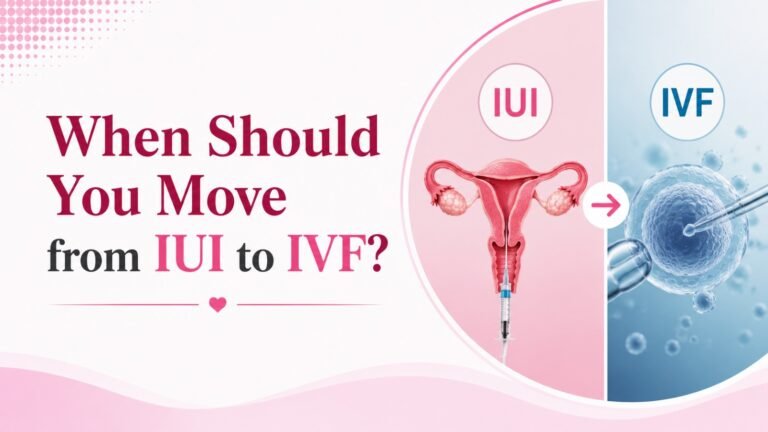
The journey through infertility treatment is different for everyone and often very complicated. For many individuals and couples looking to conceive, fertility specialists will first recommend Intrauterine Inseminations (IUI). IVF tends to be more complicated, conscripting more time, and more expense. Unfortunately, it sometimes becomes necessary to discontinue the IUI process and pursue alternative options.
The question most often posed by fertility patients is, “When should I move from IUI to IVF?“
There is no blanket answer as this decision is entirely unique. It requires a careful assessment of many factors including reproductive health, overall health, previous treatments, age, fertility diagnosis, and ovarian reserve. Choosing the right moment to switch IUI for IVF has the potential to eliminate time loss and emotional excess while increasing the likelihood of a successful pregnancy.
Understanding the Difference Between IUI and IVF
The first step in answering the question of when to switch from IUI to IVF is developing a foundational understanding of the two necessary treatment options.
What is IUI?
IUI (Intrauterine Inseminations) is the placement of sperm (which is prepared in a special way) directly into the uterus (which is timed to be most effective at the time of ovulation). Placing the sperm closer to the egg potentially increases the chance of fertilization.
IUI is a good option for:
– some male factor infertility
– infertility when the cause is unknown
– ovulation disorders
– Cervical factor infertility
– Single women or same-sex couples using donor sperm
What Is IVF?
In Vitro Fertilization, or IVF, is when the ova are extracted from the ovaries, sperm is introduced and the fertilization takes place in a lab, as opposed to the body. Once there is an embryo, that embryo can be implanted into the uterus.
Compared to other fertility procedures, IVF is much more effective.
How Many IUI Cycles Should You Try Before IVF?
The most significant of all factors is the number of IUI cycles that have been performed without success.
Most fertility doctors suggest:
– The average is 3-4 IUI cycles if the patient is under the age of 35, with the upper limit being 6 in specific, favourable fertility situations.
– Women over 35 should expect to transition to IVF much quicker.
The data suggests that most of the IUI procedures that successfully result in a pregnancy do so within the first 3-4 cycles. After that, the chances for success drop off significantly.
If a patient has not been successful at getting pregnant after a number of IUI procedures, usually IVF is the next, and more successful, step.
Signs It May Be Time to Move from IUI to IVF
1. Continued Unsuccessful IUI Cycles
One of the strongest indicators to move to IVF is when a patient has had multiple unsuccessful IUI, such that she has done:
– 3 or more medicated IUIs
– multiple properly timed IUI cycles
– sufficient sperm prep and follicle development
yet has not become pregnant.
2. Advanced Maternal Age
It is well known that as a woman’s age increases the fertility potential decreases.
Women in these age brackets may experience the following:
– 35-37 years may experience diminishing fertility potential
– 38-40 years may experience diminished egg quality, which may decline more rapidly
– Over 40 years may be better served by directly pursuing IVF, as the egg quality may be significantly diminished.
Because age plays such a critical factor in the success of the procedure, it is the consensus of many fertility specialists that the patient should move directly to the IVF procedure, rather than spending months on multiple IUI attempts, typically resulting in no pregnancy.
3. Low Ovarian Reserve
A low ovarian reserve means there are fewer available eggs. Indications of this may be:
– Low AMH levels.
– High levels of FSH.
– Low antral follicle counts.
Egg retrieval may be easier, and so IVF may be more successful, for women with low ovarian reserve.
4. Severe Male Factor Infertility
IUI may be effective when sperm quality is only mildly impaired. IVF with ICSI may be recommended when there is:
– A low sperm count
– Poor sperm quality and quantity
– Attempts to fertilization have failed in the past and may have been done outside of the normal IVF procedure.
IVF may be the better approach.
5. Endometriosis
Moderate to severe endometriosis may have an impact on the quality of eggs and embryos, as well as embryo implantation. Women with more severe endometriosis may be better served by IVF than IUI.
6. Blocked or Damaged Fallopian Tubes
IUI may be an available option if the woman has at least one healthy and fully functional Fallopian tube. If both tubes are blocked or significantly damaged, IVF may be the favoured approach.
7. Unexplained Infertility
Couples with this diagnosis may be better served by IUI for their initial option.
However, if normal test results are followed by unsuccessful IUI cycles, then the potential of IVF may be able to address hidden fertility issues that normal tests are not able to identify.
Success Rates: IUI vs. IVF
IUI and IVF both come with their respective success rates. Understanding these rates can inform your decision when choosing an option for conception.
Average Success Rates for IUI
The success rates for IUI generally have the following ranges:
– Between 10% and 20% for women younger than 35.
– Even lower for women older than 35.
– Significantly lower for women older than 40.
Average Success Rates for IVF
IVF offers the following generally improved outcomes when compared to IUI:
– 40% to 60% success rates for younger women.
– Higher overall success rates for ongoing pregnancies.
– Greater opportunities for embryo selection.
– Higher success rates for patients with complex fertility issues.
IVF is a more expensive option than IUI, but the cost of IVF may be less than the cost of multiple failed IUI cycles.
Emotional Considerations When Going From IUI to IVF
Going from IUI to IVF is both a medical decision and an emotional decision. There are many patients who experience:
– Fatigue from the emotional toll of treatment.
– Anxiety due to multiple failures.
– Concerns of the financial cost.
– Fear of more invasive procedures.
Knowing that going from IUI to IVF is a medical decision that is meant to gain a positive outcome (as opposed to a fail), can assist patients in feeling more positive in their journey.
There is a lot of clarity and reassurance that can be brought to this journey with the aid of a fertility specialist.
What To Ask Your Fertility Specialist
There are many questions that you can ask prior to the IUI to IVF transition. Some of these questions may include:
1. What are my chances of success if I do one more IUI cycle?
2. How does my age impact how you will choose the best treatment for me?
3.Will underlying fertility factors make IVF more tailored for my situation?
4. What will my specific IVF success percentages look like?
5. What will the investment and duration look like?
Your the discussions will help provide an individualized and rationale basis for treatment options.
Benefits of Moving to IVF Earlier
Making an earlier transition to IVF may offer your patients:
– higher rates of pregnancy
– quicker conception
– more effective use of reproductive years
– options for freezing embryos
– options for genetic testing
– less emotional strain due to less failed attempts at conception
The correct timing for the transition is different for every person. Delaying IVF may adversely impact the success of the overall treatment, especially for older patients.
Conclusion
Knowing when to move from IUI to IVF is a significant decision to make when it comes to fertility. Although IUI is still a successful first-line treatment option for most patients, frequent failures, advanced maternal age, decreased ovarian reserve, male factor infertility, and endometriosis and tubal factor infertility, are all strong contributors to the decision and likelihood that the patient will benefit from IVF more than IUI.
All infertility journeys are different. The most beneficial plan is for the patient to have the best and most skilled physician and to be provided with a treatment option that helps in achieving successful and healthy pregnancies the most.
If you have a factor that decreases the likelihood of a successful IUI, another option to consider is IVF faster, if your end goal is to have the family you want the most.